

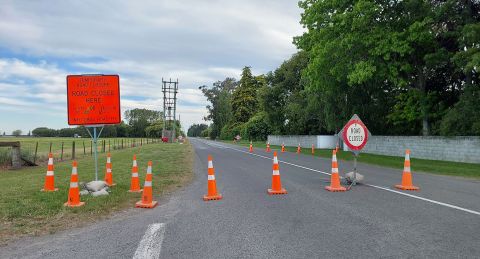
Temporary Traffic Management
What is Temporary Traffic Management (TTM)?
Methods of controlling traffic (vehicles, cyclists, pedestrians) that allow for safe movement through or around worksites, events, or accidents using permanent design principals in a temporary setting. This is typically done with the use of signs, cones and safety fencing and other devices.
What is a Traffic Management Plan (TMP)?
A document describing the design, implementation, maintenance, and removal of temporary traffic management (TTM) while the associated activity is being carried out within the road reserve or adjacent to and affecting the road reserve. A TMP details the work to be undertaken, identifies the associated risks and the reasonably practical control measures to eliminate or minimise those risks.
When is a Traffic Management Plan Needed?
A Traffic Management Plan (TMP) is typically required when an activity alters the normal operating conditions of a road, regardless of whether it takes place on the carriageway, footpath, or shoulder. This also applies to activities occurring outside the road corridor if they impact the normal operating conditions of a road.
Why is a Traffic Management Plan Needed?
A Traffic Management Plan (TMP) is required to help manage the hazards and risks that have been created by the activity and is needed to keep everyone safe as required by law.
TTM Here and Now:
This notice provides essential details about the changes in (TTM) and outlines important considerations for traffic management operators working within the Ashburton District Council Road Network.
Application Steps

When preparing your submission, ensure the activity is clearly defined by outlining its purpose, location, timeframe, and the methodology to be applied. Supplying comprehensive detail will assist in achieving a smoother more efficient planning process.
Depending on the nature of your activity, one or more approvals may be required. These may include:
- Traffic Management Plan (TMP)
- Corridor Access Request (CAR) for a Works Access Permit (WAP)
- or a WAP for Non-Utility Operators.
You must consider any safety risks, the effects on other road users and stakeholders, as well as the condition of the Ashburton Road Network.
Under the Health and Safety at Work Act 2015, risk planning is a legal requirement, which includes the obligation to consult, coordinate, and cooperate with other parties.
Your Traffic Management Plan (TMP) sets out how safety and traffic impacts will be managed. It should align with the New Zealand Guide to Temporary Traffic Management (NZGTTM) and include sufficient detail to meet our responsibilities as the Road Controlling Authority (RCA).
Once completed, your CAR and TMP can be submitted through Submitica.
Please note: TMPs prepared under the Code of Practice for Temporary Traffic Management (CoPTTM) will be accepted; however, they must still contain all information required under the
NZGTTM and relevant legislation. Older or template-based CoPTTM TMPs may not meet this standard and could require additional detail.
We will review your Traffic Management Plan (TMP) to confirm that it meets our safety, regulatory, and network management obligations.
Please note: Ashburton District Council is responsible only for the Ashburton network only. If your activity involves equipment placement or works on State Highway, you must obtain separate approval from NZTA’s RCA Temporary Traffic Management Centre.
Traffic Management Plans
Before submitting your TMP, use this checklist to ensure it meets requirements.
1. Activity and Environment Context
A clear understanding of the proposed activity and the environment where it is to take place.
2. Level of Planning
Level of planning reasonably and practically manages the risks associated with the work activity, environment, and introduced risks.
3. Evidence of Consultation, Coordination, and Cooperation
Affected stakeholders have been engaged and made aware of the proposed activity and the impact it will have on them and what measures will be taken to manage the risk.
Level of the 3C’s is determined by the network impact and complexity of works.
4. Risk Assessment
Develop a clear risk assessment that identifies risk, controls and includes an analysis of control options. Appropriate person from the lead contractor or contracting PCBU has carried out a risk review.
5. Demonstrate Competence
In accordance with the Health and Safety at Work Act 2015, you must provide suitable training, supervision, and instruction. When reviewing your TMP, we will look for clear evidence that:
- The designer has recognised temporary traffic management training or equivalent experience relevant to their role.
- An onsite supervisory role will be undertaken by a person with the appropriate competencies.
- Supervisors have a process in place to confirm the plan is suitable and is being properly implemented.
6. Risk-Based TMP
- We recommend using the New Zealand Guide to Temporary Traffic Management templates, as they consolidate key information in a consistent format, but they are not mandatory.
- TMP is approved by the Contractor PCBU.
- Upload the completed TMP to Submitica.
Note: For more guidance and information, please refer to Requirements for TMP preparation on the Ashburton Road Network v1
An EAR Form is a guidance tool that initiates early engagement with us and allows potential network impacts to be considered prior to TMP submission.
- This is an optional tool that can be used to assess the potential network impacts and the complexity of the works.
- We recommend using the tool for medium to high/critical impact sites.
- Submit all EAR Forms to TMP@adc.govt.nz
- Once submitted ADC will try to respond within two working days with acceptance, a requesting for more information or issues to be resolved before moving onto a full TMP.
A Pre-Approved Reusable Scheme (PARS) is a reusable Traffic Management Plan (TMP) for work that happens in multiple locations or needs a fast response. Instead of being tied to a single site, it sets out:
- The types of activities it covers
- The road environments it applies to
- Approved traffic management layouts
- Clear exclusions, boundaries, and decision-making rules.
PARS provides a flexible framework for on-site staff such as the Site traffic Management Supervisor (STMS), to set up appropriate traffic management for the situation and environment. Every worksite still requires a risk assessment, but PARS allows key decisions to be made on the ground.
Ideal for repetitive, mobile, or time-sensitive work (such as inspections, urgent repairs, or routine maintenance) instead of preparing a full site-specific TMP each time.
Aligned with the New Zealand Guide to Temporary Traffic Management, PARS enables faster, safe, and more efficient work across the road network.
PARS are especially useful for:
- Emergency or urgent works
- Regular inspections or surveys
- Mobile operations across wide areas
- Cyclic maintenance
Because a PARS is broader than a one-off TMP, our focus is on how your systems manage risk. Your application should demonstrate:
- Robust procedures - such as standard operating procedures, training systems, and decision-making tools that support safe operations.
- Clear scope - outlining exactly what the PARS includes and excludes.
- Fit-for-purpose layouts - a tailored list of traffic management options, rather than a generic catalogue.
- Good practice references - identifying the sources of your methods (e.g. practice notes or risk assessments).
- On-site decision-making - how your Site Traffic Management Supervisor will assess conditions and select the appropriate layout.
We’re seeking clear, concise, and practical plans that enable trained competent personnel to make safe and effective decisions on site.
PARS may be specific to a project or work activity, but all must receive approval from Ashburton District Council before they can be used.
- Prepare your documentation, ensuring that it is modular, risk-based, and easy to follow.
- Submit via Submitica using the global application function.
- Wait for ADC to review and respond.
Resources and Tools
- New Zealand Guide to Temporary Traffic Management (NZGTTM)
- WorkSafe’s good practice guideline: Keeping healthy and safe when working on the road or roadside.
- Civil Contractors NZ TTM practice note - Protecting Vulnerable Road Users in TTM Environments
- NZTA/Waka Kotahi - National Speed Limit Register
- NZTA/ Waka Kotahi - One Network Road Classification
- Land Transport Rule: Traffic Control Devices 2004
- Land Transport Rule: Setting of Speed Limits 2024
- ADC Waste Collection Days
- ADC EAR Form v1.2 - use to lodge your (Early Access Request) Form - Submit the EAR form to TMP@adc.govt.nz for review.
- ADC - Notification Board Example v1
Forms and Guidance Documents
- ADC TTM Local Operating Procedures
- Requirements for TMP preparation on the Ashburton Road Network v1
- Requirements for PARS applications on the Ashburton Road Network v1
- Road Closure Application Form v1.2
- ADC Traffic Management Plan Extension Form V1.2
- Guidelines for Notification Letters v1.2
- NZGTTM - Application Process v1.4
- NZGTTM - Operational flowchart v1.4
- 3Cs determine level of planning